


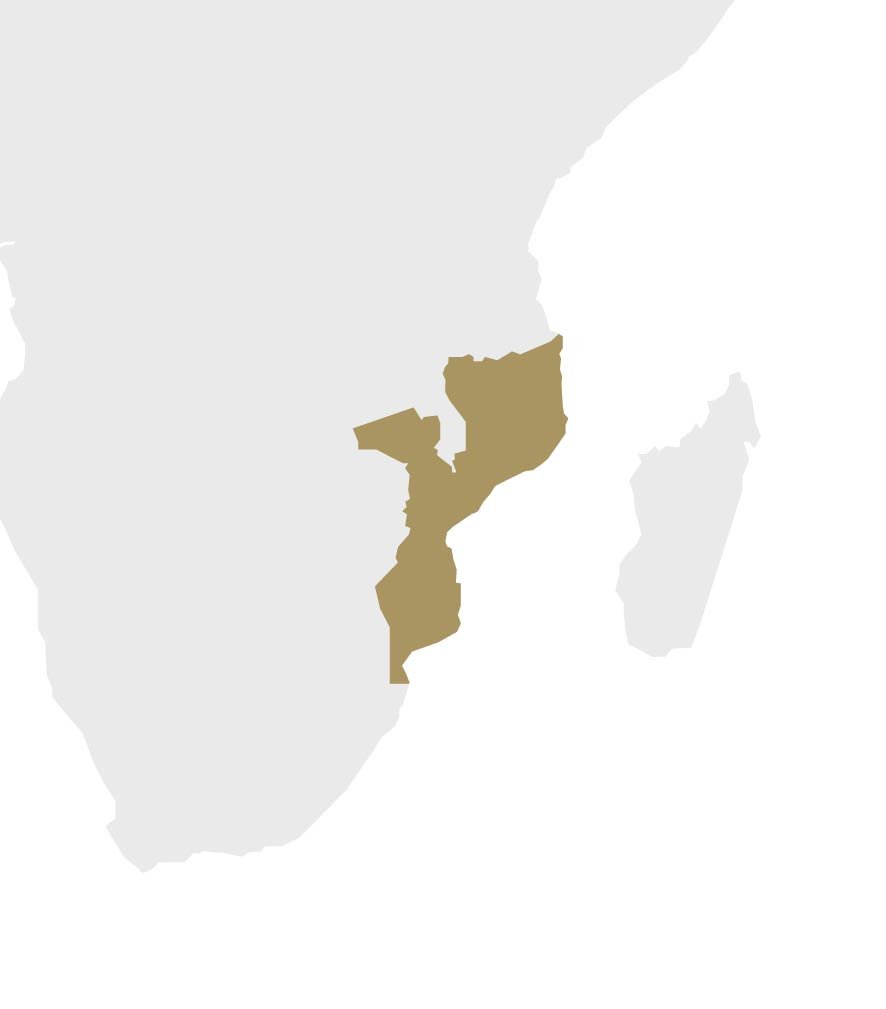
Mozambique is located in Southern Africa, bordering with South Africa, Eswatini, Malawi and Tanzania. It has a tropical climate and is rich in natural resources including gold, precious stones and metals and liquefied natural gas. Mozambique has an extensive coastline with some of Africa’s best natural harbours, giving it an important role in the maritime economy of the Indian Ocean.
Despite an abundance of natural resources and economic potential, Mozambique remains one of the world’s poorest countries. Eleven times the size of Ireland, over 70% of Mozambique’s population of 34.63 million live in poverty.
With a life expectancy of only 64 years, communities face multiple daily challenges. These include accessing basic services such as water, healthcare, education, electricity; over-reliance on subsistence farming; annual cyclones; and extreme drought and flooding. In the Northern part of Mozambique – the province of Cabo Delgado – there is an ongoing violence caused by an armed Islamic insurgency.
Mozambique achieved independence from Portugal in 1975. It is a multi-party democracy, holding Presidential and parliamentary elections every five years since the end of the first civil war in 1994. President Daniel Chapo was inaugurated in January 2025 to begin his first term of a potential two-term presidency. President Chapo was the candidate of the FRELIMO party that have held power since Mozambique’s independence in 1975.
Ireland’s relationship with Mozambique
Ireland formalised its bilateral relationship with Mozambique in 1996. The initial mandate of the Embassy of Ireland in Mozambique was centered on humanitarian and development assistance and, over the years, Ireland has built a significant reputation as a trusted development partner at the national and provincial levels. Our development portfolio spans support to social services, including: health and education; empowering the furthest behind, including women, girls and rural communities; and strengthening government systems. In recent years, our work has evolved to include support to the Government of Mozambique on peace, stability and climate action, and to encourage investments in new areas such as sustainable food systems and green and blue economies. Ireland also funds 10 full scholarships annually for young professional Mozambicans to carry out their Masters degrees in Irish universities.
In addition to our Embassy in Maputo, Ireland has two satellite offices in the provinces of Inhambane and Niassa. During the past 30 years, Ireland has invested over €60 million in basic services and infrastructure in the two provinces. The Embassy has a very positive reputation with communities and local authorities in both Inhambane and Niassa, and the programmes provide a strong example of Ireland’s commitment to locally led development. The provincial programmes also give the Embassy a unique understanding of the context beyond the capital city of Maputo, which informs our programming and policy work.
While humanitarian, development and peace assistance are key pillars of Ireland’s work in Mozambique, the Embassy also plays an important role in fostering strong links between our two countries through political relationships, trade, and cultural exchange. Despite the language barrier, there is a small and active Irish community in Mozambique. The wider Irish network includes Irish alumni (former fellows) and people with social, cultural and political associations with Ireland.
The Embassy supports the arts and culture in Mozambique while building Irish connections by linking Mozambican artists and musicians to Irish artists and musicians. In terms of trade and economic ties, over the years, Irish companies such as Kenmare Resources, Cove Energy, Kentz Engineering and Nicholas O’Dwyer International Engineering have contributed to Mozambique’s development and economy with their respective investments. Kenmare Resources has invested over €1.4 billion in a titanium sands mine in northern Nampula province where they employ almost 2,000 Mozambicans. In 2022, they contributed €17m in corporation tax to the Mozambican Revenue. It is highly regarded for its Corporate Social Responsibility and transparency.
The work of Irish Aid in Mozambique
Irish Aid’s work in Mozambique aligns with the four policy priorities of Ireland’s International Development Policy – A Better World: gender equality, strengthening governance, reducing humanitarian need and climate action.
Ireland’s Strategy in Mozambique 2025-2030 outlines four key areas of development work:
- Improving access to health and education for women and youth
- Support for good governance, human rights and peace
- Humanitarian action in response to climate and conflict crises
- Support for climate-smart agriculture to improve access to food, nutrition and jobs
Further details on our work in these areas, including some case studies, are as follows:
Health and education
The majority of Mozambicans still do not have access to quality health and education. The public health and education systems are both plagued by lack of resources, low capacity and high demand. Health providers have limited knowledge and high levels of absenteeism. Medicine stock-outs are frequent and access to medical equipment is low. Malnutrition and high levels of stunting amongst children under five have long-term health implications. In the education sector, class numbers are high and teachers themselves often lack the necessary levels of training. Less than half of children finish primary school, and by the time they are nine years old, only 5% of children can competently read. The high rate of population growth has led to a huge increase in education demands, with an additional 300,000 children turning primary school age each year.
Mozambique faces significant gender inequalities in access to health and education. The country has one of the highest rates of adolescent pregnancy in the world. Over half of girls are married by the time they are 18, and almost half of girls between the ages of 15 and 19 are already mothers. While almost all girls enroll in the first year of primary school, more than half drop out by early puberty. Thirty-seven percent of women in Mozambique aged 18–49 have experienced gender-based violence.
Ireland works with the Government of Mozambique and a number of partners to improve the health and education systems in the country. In the education sector, we also fund teacher-training in the North of Mozambique to improve learning outcomes. In health, our main focus areas are on maternal and child health, sexual and reproductive health and rights, child nutrition, community health care and health infrastructure.
Governance, Human Rights and Peace
Ireland’s Strategy for Africa aims for a peaceful and secure Africa, with respect for human rights and the rule of law. Governance and conflict prevention are priorities in A Better World.
In Mozambique, Ireland has built a strong reputation for our support to strengthening of government systems and accountability, both at central and local levels. The Embassy supported the negotiation of the post-civil war Maputo Peace Accord, and the demobilisation, reintegration and reconciliation process, and was a key convener and contributor to national level peace dialogues in Mozambique. We have been engaging on conflict prevention in Cabo Delgado through our humanitarian support, local peacebuilding, and political economy analysis, and plan to build on this work going forward.
To implement our 2025-2030 Strategy, the Embassy will focus its governance and peace work on three key areas: transparency and accountability; improved human rights; and peace and stability. Ireland will continue to support Mozambican civil society and human rights organisations to hold government and decision makers to account. We will also support government to better engage with citizens and to strengthen their systems to respond to the population’s needs. As part of our work on peace and stability, the Embassy will continue to support the National Dialogue Process in Mozambique – a cross-political party and civil society effort to reconcile differences and achieve important legislative reforms before the next elections in 2028 and 2029. We will also aim to promote human rights of those furthest behind, including people with disabilities.
Humanitarian Action
Mozambique is vulnerable to frequent climate and conflict related shocks, which disproportionately affect those furthest behind. This is compounded by a complex development and political environment, which are barriers to resilience. Long-term development and political solutions are required to address Mozambique’s interconnected crises; however, there is also a parallel need for continued life-saving humanitarian assistance, which prioritises prevention and sustainability.
Ireland has been responding to Mozambique’s frequent climate and health shocks as they occur – for example, in 2023 we supported UNICEF to combat the cholera outbreak, and in 2024 we supported responses to the El Nino related drought. Another focus area of our humanitarian work is the conflict in Cabo Delgado. Given the unpredictable nature of the conflict, many areas are not accessible for international actors. The Embassy has a diverse portfolio of humanitarian partners—UN, international NGO, national NGO, government agency team—to ensure that support reaches those in need.
In 2026, Ireland acted quickly to draw down humanitarian funding for the flood response, which has already affected more than 800,000 people. Our support is focused on shelter, water and sanitation, and health care for those who have been displaced.
Climate-smart Agriculture
Support for climate adaptation, sustainable food systems and livelihoods, and women’s economic empowerment, are key commitments in A Better World. In Mozambique, agriculture employs approximately 80% of the population but it is an under-developed area and is vulnerable to climate change. In order to transform agriculture, Mozambique needs to develop sustainable food systems that include climate smart crops and access to markets.
Ireland’s provincial programmes in Mozambique provide a strong entry point for supporting this work, through our teams based locally in Inhambane and Niassa. In recent years, the provincial teams have successfully supported the creation of sustainable job opportunities, complemented by enhanced education and skills development, particularly for women and youth. The provincial programme has a strong emphasis on climate adaptation, private sector development, sustainable food systems and nutrition.
For example, Ireland has made important investments in introducing quality, drought-resistant seeds into rural areas that are fortified with key nutrients that then multiply as locally adapted varieties. Production yields in different crops have increased and there has been vital nutritional benefits for families. Ireland has also invested in the formation of Cooperatives that has allowed farmers, and especially women, to bring excess produce to market, providing a consistent source of income.