


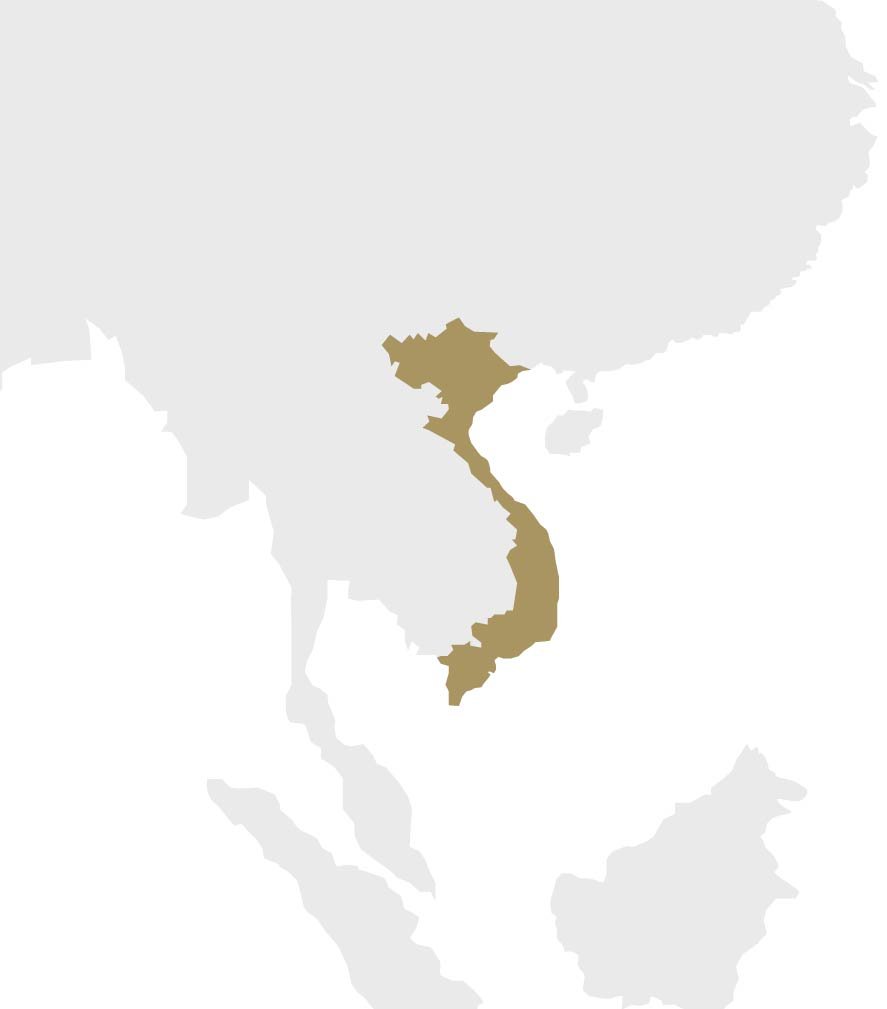
Vietnam, in southeast Asia, has a population of over 102 million and an area four times the size of Ireland.
Ireland’s Embassy in Hanoi opened in 2005. The Embassy manages Ireland's relationships with Vietnam, Cambodia and Laos.
Vietnam’s economy is a development success story. Political and economic reforms in the 1980s saw a shift from a centrally planned to a market economy. Economic reforms have helped transform Vietnam over the past four decades, from one of the poorest countries to a dynamic middle-economy. This has brought tangible improvements in people’s lives: lifting millions out of poverty; expanding access to health care and education, and connecting nearly all households to essential infrastructure. Vietnam achieved lower income status by 2016 and is aiming to achieve upper middle income status by 2030.
However, not everyone has benefitted equally from this growth. The Government reported in 2023 that 1.58 million households in Vietnam still live below the national poverty line.
There remains significant need in some regions of the country, in particular those with a relatively high percentage of ethnic minorities, who account for 15% of the national population but 79% of those living in poverty. Health outcomes and living standards have improved significantly. Infant mortality fell from 32.6 per 1,000 live births in 1993 to 12.1 in 2023, and life expectancy rose from 70.5 years in 1990 to 74.5 years in 2023 (World Bank, 2025).
Ireland's work
Ireland’s development programme in Vietnam has two overarching goals:
Promoting inclusive economic growth
To achieve this objective, Ireland supports initiatives in higher education, Agri-food and good governance.
Higher Education
In 2025, Vietnam’s initiated significant transformation to its education system highlighted by the introduction of tuition-free public education from preschool through high school, benefiting millions.
Under the Vietnam Ireland Bilateral Education Exchange (VIBE) programme, Ireland supports collaborative projects between Vietnamese and Irish education and research institutions, focusing on curriculum development, joint research and people-to-people exchanges.
Under the Ireland Fellows Programme (IFP), a number of master’s degree scholarships are awarded to Vietnamese students each year.
Climate Change
Vietnam’s agricultural sector faces intense, challenges driven by the acceleration of climate change and shifting global market dynamics. Record-breaking numbers of storms and tropical depressions in 2025 resulted in over 545,000 hectares of damaged rice and crops. In addition to storms, Vietnam faces prolonged droughts in the Central Highlands and flash floods/landslides in the Northern mountainous regions.
In 2025, The Government of Ireland offered humanitarian support, in collaboration with UNICEF Vietnam, to children and communities in storm and flood zone regions, providing access to access safe drinking water. Disaster preparedness support to households was provided, working through national authorities, to enable them to better support families in coping with the wider emergency needs that result from the cycle of natural disasters of typhoons, severe storms and flooding.
In 2026, Ireland supports Vietnam’s Just Energy Transition Partnership (JETP) by funding United Nations Development Programme Vietnam to operationalise the just transition agenda through policy support to the JETP Secretariat and a pilot Local Just Energy Transition Facility that strengthens institutional coordination, expands access to green and affordable energy finance, and promotes reskilling and sustainable livelihoods.
Agri-Food
Ireland works with Sustainable Food Systems Ireland (SFSI) under the Ireland Vietnam Agri-food Partnership (IVAP) to support Vietnam’s food systems transformation. IVAP focuses on improving sustainability, quality, safety and innovation in the agri-food sector, and is implemented in cooperation with Vietnam’s Ministries of Agriculture and Environment, the Irish Department of Agriculture, Food and the Marine, and various other Vietnamese and Irish stakeholders.
The Embassy also supports a sustainable agriculture project in several provinces, working with smallholders to implement sustainable farming practices.
Support provided to university partnership between Vietnamese university and Irish university in research on food safety and development functional ingredients and algae-based foods that meet nutritional needs and support sustainable marine farming.
Governance
Ireland works to promote good governance in Vietnam through support for a major United Nations Development Programme (UNDP) survey, the Vietnam Provincial Governance and Public Administration Performance Index (PAPI). PAPI analyses public opinion on the quality of public services across all provinces in Vietnam, and supports provinces in improving public service delivery and increasing representation for marginalised groups.
Ireland also supports improved women’s political participation in four provinces in Vietnam through training and networking activities for female political representatives and candidates, and advocacy efforts to improve women’s representation.
Reducing vulnerabilities and supporting the ‘Furthest Behind’.
To achieve this objectives, Ireland supports initiatives for ethnic minorities, nutrition and humanitarian mine action.
Ethnic Minorities
Support for ethnic minority communities has been a longstanding part of Ireland’s programme of assistance in Vietnam. Since the inception of the programme, Ireland has invested some €70 million in this area.
The programme focusses on community-based infrastructure management, climate and disaster resilient livelihood initiatives, women’s economic initiatives, and support for people living with disabilities.
Nutrition
Vietnam faces challenges with malnutrition, with significant progress in reducing undernutrition alongside rising rates of childhood overweight. The country ranks 60th on the 2025 Global Hunger Index with a moderate score of 11.1. Child stunting decreased to 18.2% by 2023, meeting earlier targets, but high disparities persist, particularly in rural and ethnic minority areas, alongside increasing urban obesity.
Ireland supports better nutrition outcomes for women and children in Vietnam through a programme focussed on maternal, infant and young child nutrition, implemented in both rural and urban hospitals countrywide. A key aspect of this programme is the transfer of expertise and learning from Vietnam to Cambodia and Laos.
Humanitarian Mine Action
Unexploded bombs, mines, and munitions are present across all provinces, particularly the Central, Central Highlands, and northern border regions. 40,000 lives have been lost and more than 60,000 people injured as result. Accidents continue to occur, impacting farmers, children, and rural communities.
Ireland is committed to contributing to a safer Vietnam through supporting a humanitarian mine action programme in the central regions of the country. This work has been a core part of the Embassy’s programme in Vietnam for over a decade. Ireland has been working on clearance of mines and unexploded remnants of war and mine risk education in the region since 1998.