


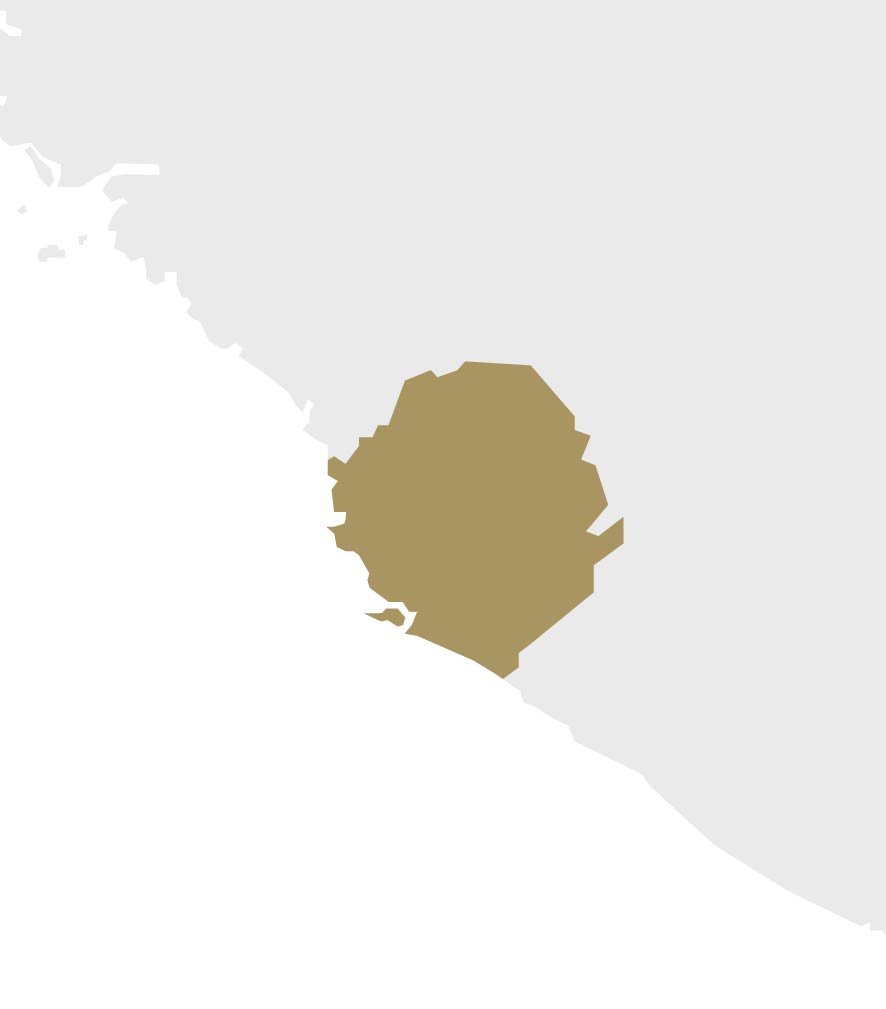
Sierra Leone is an English-speaking country on the west coast of Africa. Similar in size to Ireland, it has a population of 8.8 million.
Famed for its long, sandy beaches, Sierra Leone has a growing tourism industry. It is abundant in natural resources, including iron ore, diamonds, gold and marine resources. There is also good rainfall and agricultural prospects.
However, a legacy of conflict, political division, weak governance and poverty remain. More than half of the population lives below the poverty line. People in Sierra Leone are extremely vulnerable to climate change impacts.
Ireland’s relationship with Sierra Leone
Ireland has been supporting the people of Sierra Leone since 2002. We opened a development programme in 2005. In 2014, Ireland opened an embassy in the capital city Freetown. Our embassy team has further strengthened Ireland's partnerships across the country.
Ireland's work in Sierra Leone has a strong focus on climate adaptation, empowering women and girls through increasing gender equality and improving education, nutrition and food security, and governance.
Background
Sierra Leone faces significant economic and development challenges. Services such as education and health lack sufficient funding. Incomes are low and job opportunities, especially for young people, are limited.
Ireland’s work in Sierra Leone is largely focused on supporting women and girls.
Sierra Leone has high rates of gender-based violence and teenage pregnancy. Girls face barriers that prevent them from accessing or completing education.
Sierra Leone is also one of the most climate-vulnerable countries in the world, and increasingly faces adverse events such as extreme heat, droughts, wildfires, and floods.
Ireland’s work in Sierra Leone is grounded in Ireland’s foreign and international development policies and the Government of Sierra Leone’s development priorities. Our work builds on deep historical relations and strong development cooperation partnerships.
Our ambition is to advance Ireland’s values and interests, and contribute to the achievement of the Sustainable Development Goals, with a focus on marginalised women and girls.
Irish Aid's work
Ireland's work in Sierra Leone covers four main areas:
Gender equality
Ireland is delivering transformational gender programmes in Sierra Leone. These programmes help empower marginalised women and girls to be safe to pursue improved livelihoods and control decisions affecting their lives. This includes supporting legislative reforms, supporting free Sexual and Gender Based Violence (SGBV) services, and working with communities to change social norms that perpetuate SGBV and Female Genital Mutilation (FGM). A key element of Ireland’s work in Sierra Leone is empowering adolescent girls by building their self-esteem, resilience and capabilities.
However, like many countries, women in Sierra Leone face high levels of SGBV and persistent barriers to engaging in decision-making.
Promoting gender equality
Ireland’s work is focused on:
- Tackling the underlying factors that lead to gender inequalities
- Reducing levels of gender-based violence, including adolescent pregnancy and FGM
- Supporting survivors of sexual and gender-based violence
- Empowering marginalised women and girls.
Programmes we fund educate women and young girls on gender-based violence and sexual and reproductive health and rights; support survivors access free SGBV services; improve women’s livelihood options; develop women and girls advocacy and leadership skills for increased participation and decision making in the home, communities and nationally; and raise awareness of the intersectionality of climate change and its disproportionate impact on women and girls.
We also work with community leaders, men and boys to change behaviours. We believe and women and girls should play an equal and full part in society. Changing discriminatory social and gender norms is key.
Nutrition and Food Security
Malnutrition continues to be a real problem across Sierra Leone. The country has seen some improvements through the implementation of Feed Salone, the flagship national initiative designed to transform Sierra Leone’s food systems from subsistence and dependency to a resilient, commercial, nutrition-sensitive, and technology-driven agricultural sector.
Despite these efforts, malnutrition continues to contribute to high rates of child morbidity and mortality. Ireland supports programmes that tackle malnutrition and food insecurity.
We work with national and international NGOs, UNICEF, WHO and the World Food Programme to treat and manage malnourished children through improved child feeding practices and households cultivation of diverse nutritious foods.
Our work in this area also looks at integrated food production systems, and the adoption of Climate-Smart Agricultural practices, particularly among smallholder farmers to build resilience to climate change.
Education
Despite improving enrolment rates, Sierra Leone's basic education sector still faces significant challenges.
Ireland supports the Government of Sierra Leone to strengthen national education systems to deliver equitable, inclusive and quality education for all children, especially those furthest behind.
We also support efforts to reduce violence in and around school, one of the main barriers to children attending school. Working with local NGOs to ensure that children stay in school, safe and learning. Ireland is helping to improve school management and leadership in a number of under-performing schools.
Governance
The passage of progressive laws in 2022, including the The Gender Equality and Women’s Empowerment Act and the Public Elections Act, combined with sustained support for women’s political and economic empowerment, has significantly increased women’s participation in leadership roles at all levels.
Ireland works at national and local levels through national institutions and civil society to advance accountability, human rights , peace and social cohesion. This includes working in support of electoral reform and electoral cycles through the Electoral Commission of Sierra Leone and supports to NGOs, women’s organisations and UN Women to promote and encourage women to participate in politics and stand for elections.
In the 2023 national and local elections, women filled 30% of elected parliament seats, 34% of local council seats and 55% of elected deputy chairperson/mayor positions. Roughly one-third of Ministers (32%) and Deputy Ministers (38%) were women.
Case study: Supporting women’s rights in Sierra Leone
Women’s Community Solidarity Groups (WCSGs), supported by Irish Aid, are transforming the lives of thousands of women in Kambia District in Sierra Leone.
The Women's Rights Advocacy Group (WRAG) is one such group, supporting women farmers in accessing land and improving their livelihoods.
Their work is deepening cohesion among women, empowering them and supporting women’s participation in local governance. WRAG is now one of the leading community based organisations in Kambia District.