


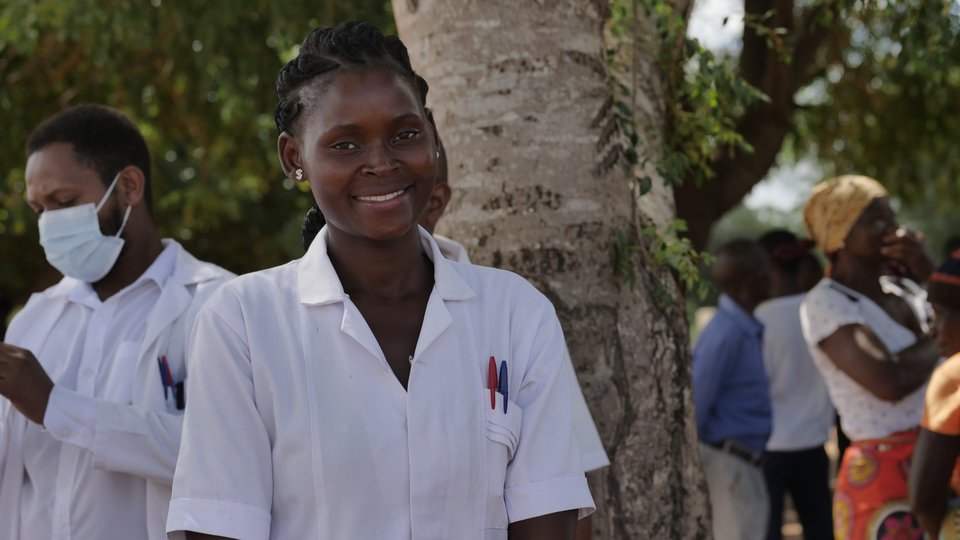
Reaching those furthest from health services in Inhambane Province
Caring for people as a nurse in a rural Mozambican health centre is not for the faint of heart.
Twenty-eight year-old Maria Antónia Cossa wakes up every morning to walk long distances to reach the health centre where she works with five other colleagues.
Far away and with no running water, caring for patients, assisting with about 20 births a month, treating malaria, scabies, diarrhoea and HIV is not an easy task.
Opening of Chitanga Health Centre
In 2024, the Irish Embassy in Mozambique financed the completion of the Chitanga Health Centre. The facility is close to the community and features a fully equipped maternity ward.
The health centre services an isolated population of 30,300 people, 85% of whom are women and girls.
Solar-powered water supply system
To ensure proper care for patients, particularly women and children, a water supply system powered by solar energy was also built with Irish funding in 2023.
Now, Maria Cossa and her colleagues can guarantee proper hygiene conditions and cleanliness of the maternity ward.
For Belita Bernando, a thirty-five-year-old mother of five children, having a health centre closer to home means that she can seek assistance early on, as opposed to doing so only when health issues worsened.
“I have a lot to thank you for. Sometimes I couldn't even go to the health centre because there was no way to carry the children when they were sick. Now I can come and be treated. We also have water nearby, so it's easier for us.”
The health centre provides sexual and reproductive health care and Belita can also receive support for family planning.
The water system, now completed and fully operational, provides safe drinking water all year round to about 12,500 inhabitants of Chitanga community.
Reducing maternal mortality
In collaboration with government, the Embassy of Ireland in Maputo supports the expansion and improvement of basic health services in the region.
This support aims to reduce maternal mortality and morbidity due to chronic malnutrition, malaria, tuberculosis, HIV, noncommunicable diseases and preventable diseases as well as support for contraception.