
When Twinned Towns say “I Do”
From civic friendship to cross-border romance, there’s love in the air between Ireland and Germany
When people think of town twinning, romance is usually not the first idea that comes to mind. In post-war Europe, town twinning partnerships were a practical and symbolic way of binding communities together. It was about reconciliation, cultural curiosity and the exchange of ideas.
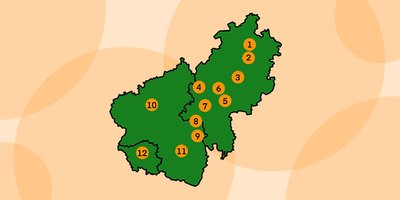
Ireland has 18 twinned towns across all of Germany, with the majority of them (13 in total) situated in the two large southern states of Bavaria and Baden-Württemberg.
Generations of twinning
Many of these twinning partnerships have existed for decades, and 2025 was a special year for many of them as, by our count, six were celebrating notable anniversaries. Carrigaline, Co. Cork, and Markt Kirchseeon celebrated 10 years of town twinning in 2025. Bray and Co. Wicklow marked 25 years of the original twinning of Bray with Würzburg, as did Ballybay, Co. Monaghan, with Osterhofen, and Castlebar, Co. Mayo, with Höchstadt an der Aisch. Sligo Town and Kempten, and Hohenlohekreis and Limerick City and county, all marked 35 years of twinning.
These significant anniversaries of partnerships between towns, villages and counties across Ireland and Germany are a sign of the strength of the ties between our two nations, as well as the enthusiasm with which Irish and German communities continue to connect… sometimes in more ways than one.
Love breaking borders
From the 1970s onwards, Irish and German towns paired off with enthusiasm. When driving into many towns across both countries today, it is not unusual to see a road sign with the crests of partner towns listed proudly.
Brass bands travelled, football teams exchanged jerseys, and school students discovered that while customs might differ, hospitality did not. The programmes were well planned, yet it was beyond the official schedule that the real charm emerged. For some, these encounters led to lifelong partnerships.
Clonakilty, Co. Cork, and Waldaschaff in northern Bavaria have been twinned since the summer of 1989. As one of the most active twinning partnerships, many friendships have grown and in some cases also romance, as no less than five marriages have ensued between couples from both towns.
Sigrid and Michael
Sigrid and Michael Martin’s story begins even before the official signing of the twinning agreement between Clonakilty and Waldaschaff, and it all started with a shared love for music.
During Easter 1985, Michael travelled with the Clonakilty Brass and Reed Band to Waldaschaff, where he met Sigrid for the first time. The following year, the Waldaschaff Musikverein (music society) visited Clonakilty on a return visit.
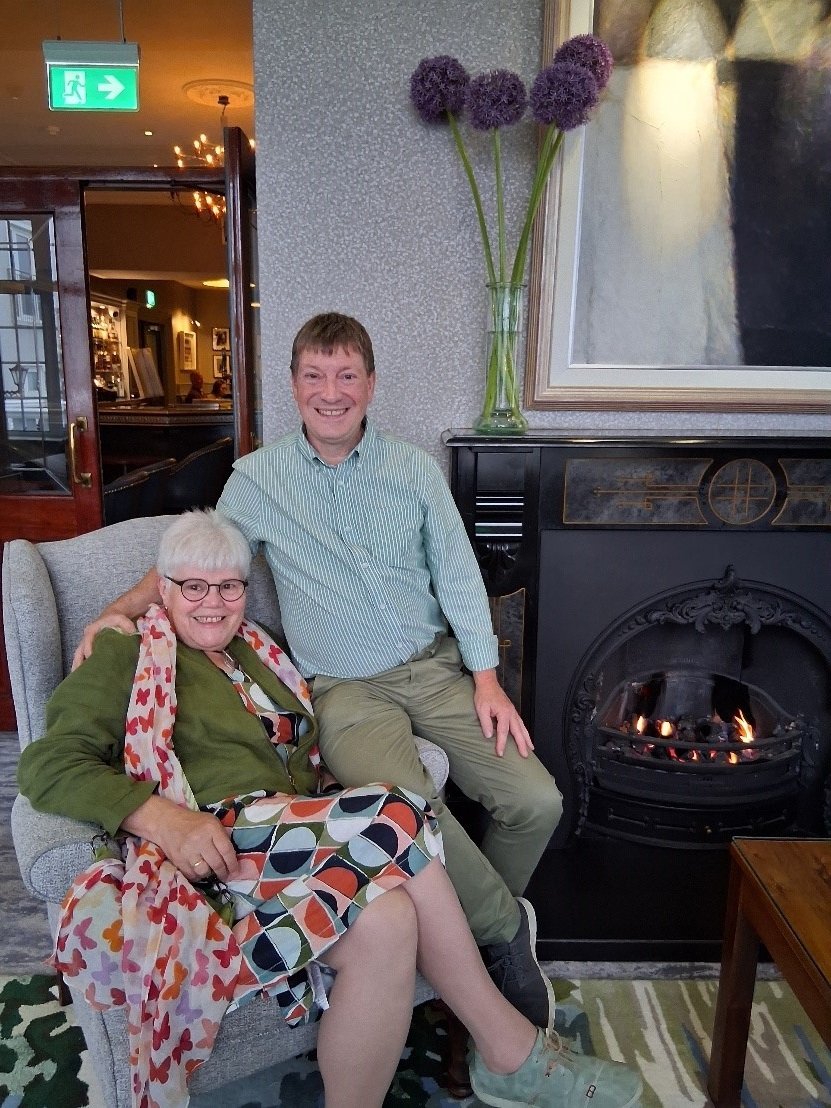
The two stayed in touch, and in January 1988 Michael visited Waldaschaff again in a private capacity and “that was when it all clicked”. Later that year, after Sigrid visited Ireland again at Easter, Michael moved to Germany.
Michael arrived to Waldaschaff four weeks later with two suitcases and his cornet, and the rest is history
They got married in May of 1990, and this was the first of the German-Irish marriages to come from the Clonakilty-Waldaschaff twinning. 36 years later, Sigrid and Michael have had two sons and a daughter, as well as two grandchildren, and have managed to travel to Ireland twice a year since (except during the pandemic). “It’s a home away from home for us!” said Sigrid.
Anne Marie and Klaus
Anne Marie and Klaus Schorowsky are one of the more recent matches to come from this particular twinning. Anne Marie and Klaus met 11 years ago in the summer of 2015 during celebrations to mark the 25th anniversary of the twinning on the Irish side.
Anne Marie was approached by the First Mayor of Waldaschaff, Marcus Grimm, and the local priest, Fr. Manfred Hock, who told her “they had a man for her”.
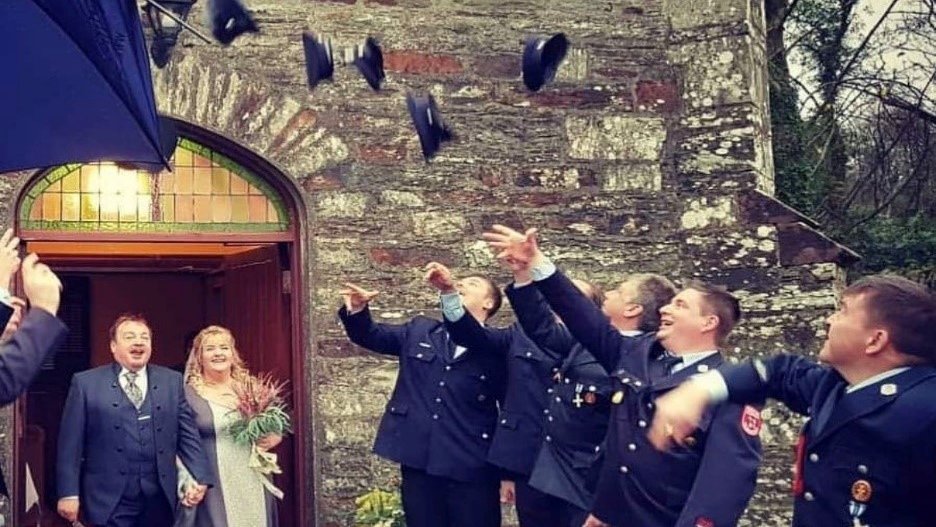
“In true Irish fashion, I just laughed it off!” she says. Just three years later Anne Marie and Klaus were married, with their celebrations crossing borders.
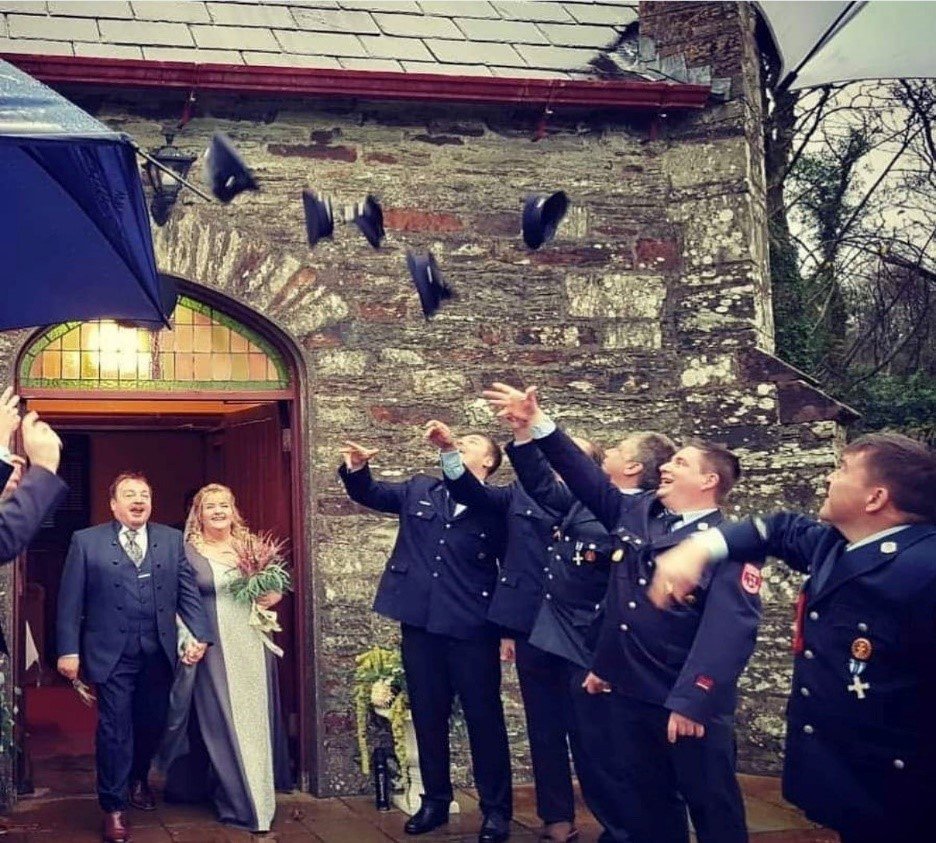
In Germany, they hosted a ‘Polterabend’ style party, a German pre-wedding tradition, where friends and family bring breakable items such as plates, flowerpots and even toilets to be smashed in front of the couple’s home. As a forecast of what their new marital life will look like, the couple clean up the mess together.
This tradition is always followed by a big party, and over 100 Irish people travelled to Germany to celebrate with the couple. Three weeks later, they got married not far from Clonakilty, in Rathbarry, Co. Cork, and have never looked back.
Anne Marie sits on the committee of the twinning association, and has been heavily involved with it, together with Klaus, for years. They divide their time between Clonakilty and Waldaschaff throughout the year, with Anne Marie working in Dunmore House Hotel from May through September.
She has assisted students from Waldaschaff in their hunt for summer work, helping them to secure jobs in Clonakilty, not only to practice their English, but also to learn about Ireland and Irish people first hand. These connections, however small, only help to ensure the longevity of a project that has resulted in decades of friendship.
Ruth and Morgan
It’s not just in Clonakilty and Waldaschaff where love is in the air. Tuam, Co. Galway, and Straubing in eastern Bavaria will mark 35 years of town twinning later this year, having signed their twinning agreement in 1991.
One couple to find love in these twinned towns is Ruth and Morgan O’Connor. Ruth and Morgan met in 2001 while Ruth was on Erasmus in Galway from the University of Regensburg. Ruth chose Galway as the place to spend her Erasmus year, rather than England or the United States, as she had such positive memories of the west of Ireland from a school exchange to Tuam years before.
During a student party, on a Wednesday night, Ruth began chatting to Morgan, from Spiddal, Co. Galway, who was working as an Irish and history teacher in the city.
We exchanged phone numbers, met up again at the weekend and it was clear to both of us very quickly that we had met someone very special
After her Eramsus year came to an end, Ruth returned to Regensburg and instantly started working on a transfer to finish her degree in Galway. “This was pre-ECTS [the European Credit Transfer System, which enables the transfer of university credits between institutions] so I was relying on a bit of goodwill from the lecturers and professors. We got married soon after.”
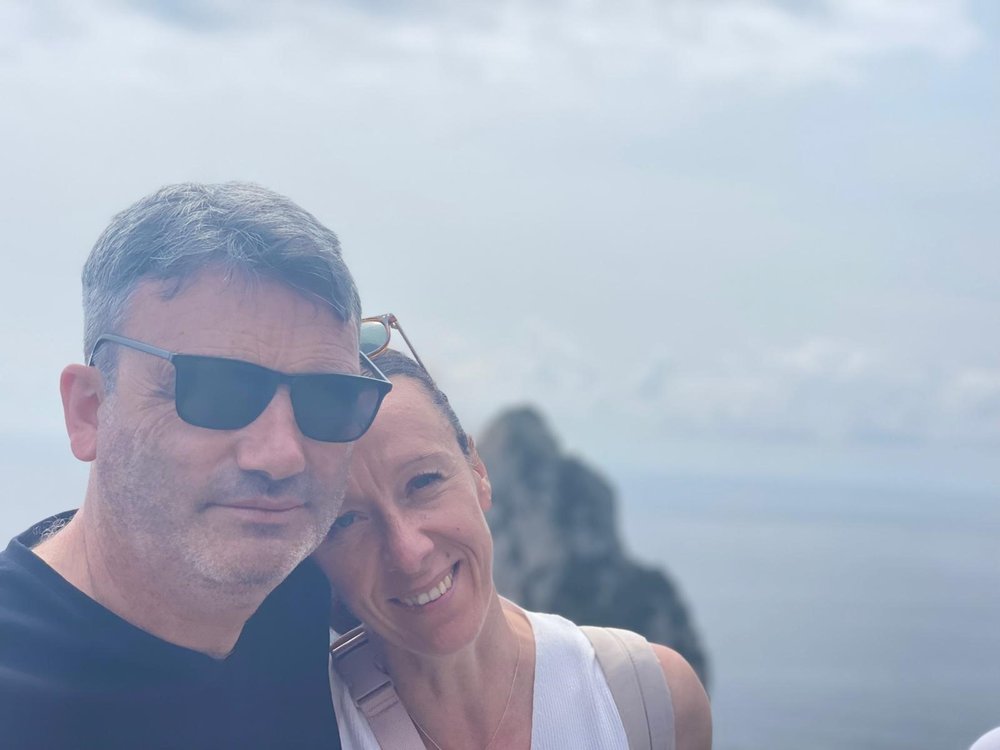
25 years later, Ruth and Morgan have three children and live in An Spidéal. Their children speak English, Irish and German. When moving to a Gaeltacht area, the Irish language was initially a huge challenge for Ruth. Their three children have all attended Gaelscoileanna, schools which operate entirely through the Irish language, and all communication from the schools was in Irish. “It took me a while to learn, but I get a lot of practice!”
To mark the 35th anniversary of the twinning project, the Lord Mayor of Straubing will be travelling to Galway in April of this year, though for Ruth and Morgan, 2026 marks a special anniversary of their own – 25 years together.
If it hadn’t been for the twinning and my subsequent school exchange to Tuam, I would never have thought of spending my Erasmus year on the west coast of Ireland, and I would have never met my soulmate
The lasting connections
This Valentine’s Day, the love stories born of Irish-German town twinning offer a meaningful reminder of what European cooperation can look like at its most human.
Long before policy documents and funding rounds, twinning trusted in the simple power of the encounter; that if people met often enough, ate together, laughed together and learned from one another, something lasting might grow.
As towns continue to renew and reimagine their partnerships, the outcomes may be measured in exchanges organised or projects completed. But, quietly, there may be another outcome entirely. At the back of a reception hall, two people may be discovering that a town twinning can, with a little luck, become a life twinning too.