


Ambassador Gormley's Address at IDAHOBIT 2026 in Johannesburg
'At the United Nations, through the Human Rights Council and the General Assembly, and in partnership with civil society organisations around the world, Ireland continues to advocate for the protection and promotion of LGBTQI+ rights.'
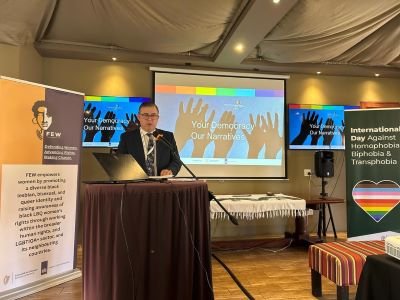
It is a privilege to join you today for this important IDAHOBIT Colloquium under the powerful theme:
“In the Heart of Democracy: Your Democracy, Our Narratives.”
At the outset, I would like to sincerely thank all those involved in organising today’s event and for their continued commitment to advancing dignity, equality and inclusion for LGBTQI+ persons in South Africa.
I also wish to thank our longstanding partners, the Kingdom of the Netherlands, for continually working with us to advance human rights, dignity, equality and inclusion. Partnerships such as these matter deeply because they remind us that defending human rights is never the work of one institution or one country alone — it is collective work, rooted in solidarity and shared values. Today’s programme asks an important and difficult question:
What does democracy truly mean if equality is a legal right, but it is not realised in people’s lived experience?
The conversations throughout the day will challenge all of us to confront the gap that can exist between constitutional promise and daily reality.
And this is precisely why this event is so important for Ireland.
Ireland’s commitment to human rights includes advocating against discrimination and supporting the rights of LGBTQI+ individuals to live with dignity, safety and equality. We believe that human rights are universal and indivisible, and that no person should face violence, harassment, exclusion or fear because of who they are or whom they love.
This commitment is not only part of our domestic values — it is also a key pillar of Ireland’s foreign policy.
At the United Nations, through the Human Rights Council and the General Assembly, and in partnership with civil society organisations around the world, Ireland continues to advocate for the protection and promotion of LGBTQI+ rights.
As Ireland campaigns for a seat on the Human Rights Council, for the 2027 to 2029 term, I can assure you that we will continue to ardently oppose any efforts that seek to roll back hard-won freedoms and protections.
This work is especially important at a time when we are seeing increasing pressure on LGBTQI+ rights globally, including rising hate speech, discrimination and organised anti-rights movements.
That is why spaces like today matter. They create visibility. They create dialogue. And importantly, they center lived experience as a source of political and social truth.
The stories shared today are not simply personal experiences — they are reflections of how democracy is experienced in practice. They remind us that equality cannot live only in constitutions, courts, or policy documents. Equality must also live in communities, institutions, schools, police stations, workplaces, families and everyday interactions.
In 2015, Ireland became the first country in the world to introduce marriage equality through a popular vote. That moment represented more than legal reform — it reflected a broader social transformation driven by courageous activism, storytelling, public dialogue and community mobilisation.
The progress Ireland has made was possible because LGBTQI+ individuals and civil society organisations insisted on being seen, heard and recognised. Their stories changed hearts, challenged prejudice and expanded the meaning of equality within our democracy.
That experience continues to shape how Ireland engages internationally today.
We understand that progress is neither automatic nor guaranteed. We understand the importance of civil society leadership. And we understand that democracy must constantly be renewed through inclusion, accountability and respect for human dignity.
Today’s colloquium reflects those same principles.
I particularly want to acknowledge the courage of all those who continue to share their stories, organise their communities, support survivors and advocate for justice, even in the face of hostility and discrimination. Your voices are essential, and your experiences matter.
As we participate in today’s discussions, may we all be reminded that democracy is strongest when every person can live openly, safely and with dignity.
And may today strengthen our collective commitment to building societies where equality is not only promised in law, but fully realised in everyday life.
Thank you.
You may also be interested in these articles

19 May 2026
Ireland Appoints Five New Talent & Innovation Attachés — South Africa Confirmed as a Host Location
Read more
8 May 2026
Finance Officer - Temporary Vacancy
Expected Start Date: 1 July 2026. The successful candidate will be employed on a temporary six month fixed term contract, subject to satisfactory completion of a probationary period.
Read more
30 April 2026
Request for Tenders: Mapping Ireland's Economic Profile in Sub-Sahara Africa
Read more
23 March 2026