


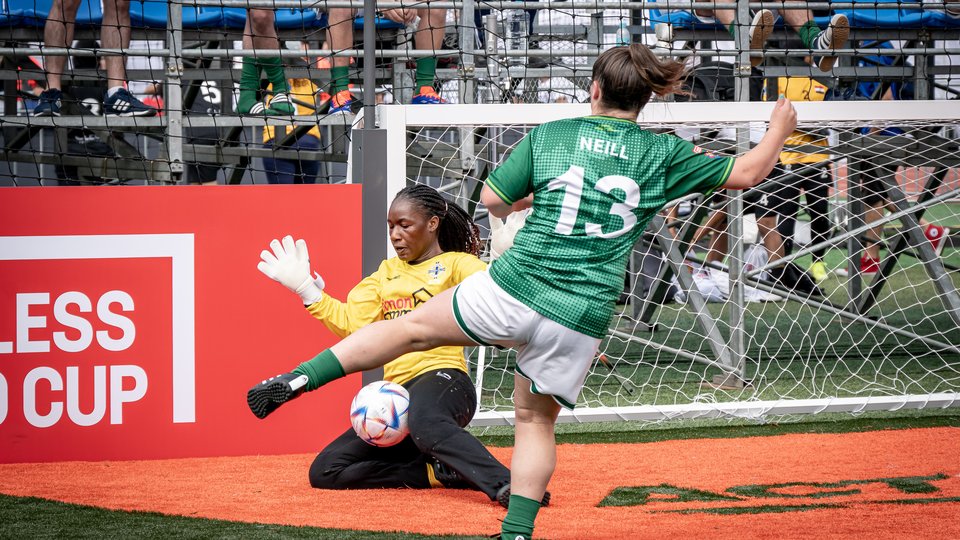
Homeless World Cup South Korea: A ball can change a life
A university campus on the outskirts of Seoul was the unlikely venue for a life-changing week of sport and camaraderie for the Irish participants at the 2024 Homeless World Cup.
Through the universal language of sport, the tournament brings together individuals with experience of homelessness and social exclusion to break barriers, get involved in something bigger and have fun along the way.
The Homeless World Cup is also an opportunity to inform and shape attitudes towards this global issue. The event has been in the spotlight in recent years, and has strong support through endorsements from high-profile ambassadors such as Colin Farrell and Bill Nighy.
A striking success for Team Ireland
This year in South Korea, the Irish Women’s Team scored 42 goals across 10 games and beat the USA 5-2 in their Trophy Stage Final to wrap up the tournament in style.
The Men's side finished 8th overall after a defeat to our neighbours, Northern Ireland, in their Trophy Stage Final.
The Boys and Girls in Green were engulfed by an outpouring of support from the Irish community in Korea, including well-known Irish businesspeople, the Irish Association of Korea, and the staff of the Irish Embassy.
One member of the Irish community in Seoul said: “This may be the biggest week in Irish football since Italia ’90.”
A ball can change a life
The selection of players to represent Ireland is not just based on their footballing ability. Their commitment to their training programmes, positive attitudes, teamwork, health and wellbeing all play a role in their selection.
Representing their country is validation of their efforts and can be life changing, according to the Irish Homeless Street League, a voluntary organisation that trains, selects, and supports the players in advance of, during, and after their participation in the international tournament.
The Football Association of Ireland (FAI) is one of the only national football associations to officially ‘cap’ the HWC players in recognition of their efforts.
“We never thought that we would represent Ireland around the world,” said Alison Ryan, a member of the women’s team. “It was like a 5-star treatment, especially pulling on our Irish jerseys with our names in Korean on the back.”
She went on to describe the sense of community among the players and the enduring friendships and support systems offered by IHSL, including a follow-up programme with a Social Coach upon return to Ireland after the tournament. “It’s like a lighthouse down the road, you know you have somewhere to go.”
Hayleigh Power, another member of the women’s squad, who came away feeling she knew her teammates all her life, echoed this sentiment. She commended the IHSL coaches and volunteers, describing them as “people who really believe in us and see what we’re capable of”.
“I don’t think people realise the work that goes on in the background … There’s a lot of work that isn’t seen, from financial costs to people giving up their time … The street league is changing people’s lives and they don’t just leave you there when the tournament is over,” she explains.
No story too big or too small
Both players also spoke of the solidarity shared between participating teams. The women’s squad stayed at the same hotel as their Kenyan counterparts and developed a special friendship with the team over the duration of the tournament.
“Sport can be a great leveller,” according to Ryan. “From Sweden to Switzerland, on the pitch, everyone is equal, irrespective of his or her background, the language they speak or the challenges they may be facing in their lives.”
“There’s no story too big or too small,” said Power. “It was all these different backgrounds coming together to form a team and represent their country.”
In addition to their newly-acquired silverware, the players came home with a renewed sense of purpose, belonging, and self-confidence as well as a determination to raise awareness about the life-changing potential of the sport and the Irish street leagues.
As Power put it: “People like us don’t think that things like this happen to people to like us, but they do.”