


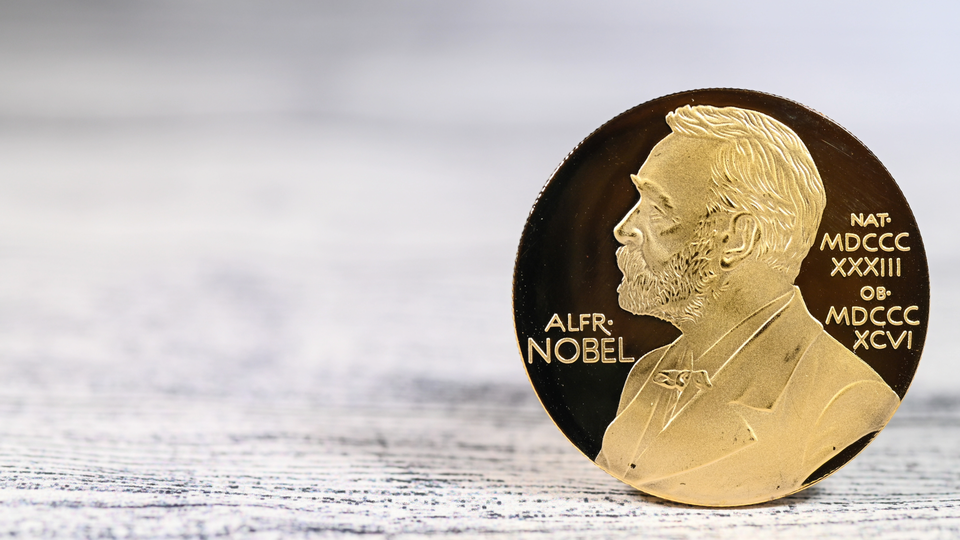
Marking 50 years since Seán MacBride’s Nobel Peace Prize
On 10 December 2024, we mark 50 years since Irish statesman Seán MacBride was awarded the Peace Prize by the Nobel Committee, for his efforts to secure and develop human rights throughout the world.
On the night in 1974, Prime Minister of Japan Eisaku Sato was also awarded the Nobel Peace Prize for his work on nuclear disarmament. This year, 50 years after MacBride and Sato received the award, Nihon Hidankyo, a Japanese group representing nuclear disarmament campaigners and atomic bomb survivors, will receive the award in Oslo. It is fitting that with these parallels, we remember Seán MacBride as the first Irish winner of the Nobel Peace Prize.
In his Nobel lecture, MacBride said:
“The big powers are traveling on the dangerous road of armament. The signpost just ahead of us is 'Oblivion.' Can the march on this road be stopped? Yes, if public opinion uses the power it now has.”
Seán Mc Bride’s enduring legacy remains an inspiration for all who work to advance the cause of human rights and the rule of law today. The promotion and protection of human rights remains at the core of Ireland’s foreign policy, as is our commitment to multilateralism and the United Nations.
MacBride’s political background
Born in Paris in 1904, MacBride was the son of the Irish actress and patriot Maud Gonne, and Major John MacBride, who was executed in 1916 for his part in the Easter Rising. In his adulthood, Seán MacBride played an active role in the War of Independence and Civil War before practicing as a lawyer. He went on to serve as Minister for External Affairs of Ireland from 1948-1951.
During that time, he played a leading role in the establishment of the Council of Europe and securing acceptance of the European Convention on Human Rights. He held the position of Vice President of the Organisation for European Economic Co-operation, which preceded the OECD, between 1948 and 1951.
Following his political career, MacBride dedicated himself to global human rights issues, becoming an active member of several international organisations. In 1961, he cofounded Amnesty International, which today is a movement of 10 million people fighting against human rights abuses across the globe. In Dublin, Amnesty International Ireland is based in Seán MacBride House, recognising his legacy.
In 1973, he was elected by the UN General Assembly to the post of High Commissioner for Namibia, with the rank of Assistant Secretary-General. As Chairman (1968-74), and later President (1974-85), of the International Peace Bureau (IPB) he launched the Bradford Proposals on World Disarmament which focused on general and complete disarmament as the primary objective of the United Nations. Coming during a period of Cold War détente and arms control dialogue, the work of the IPB would feed into the first UN Special Session on Disarmament in 1978.
Each year the IPB awards a special prize named the Seán MacBride Peace Prize to a person or organisation that has done outstanding work for disarmament or human rights. Previous Irish winners include President Michael D. Higgins (1992), and John Hume (1998).
MacBride receives the Peace Prize in Oslo
Prioritising disarmament
MacBride’s historic Nobel Peace Prize came off the back of much of this work. At the ceremony in Oslo, Norway, the Norwegian Nobel Committee said: “Seán MacBride has sought to include binding provisions on human rights in international conventions and was an early advocate of a high commission for human rights within the United Nations."
In his acceptance speech, MacBride placed nuclear and general disarmament first amongst his concern in his eight principles for peace. “The right of an individual to refuse to kill, to torture, or to participate in the preparation for the nuclear destruction of humanity seems to me to be fundamental,” said MacBride.
He also highlighted also the need for a ‘real and decisive’ role for women in disarmament:
“In my life I have found that women have a much better understanding of the imperatives of peace and are much less easily “taken in” by the specious arguments of experts or diplomats. They should be given a real decisive role in all disarmament negotiations and conferences. War and peace is surely the concern of women as much as it is that of men – and perhaps much more so."
Through his work, MacBride built on and strengthened Ireland’s international role on disarmament, and we remain at the forefront of those efforts today.
Ireland’s role in non-proliferation today
Ireland continues to advocate for gender and disarmament as a priority. His example shows the need to make progress on disarmament even in difficult geopolitical times. Just as he advocated for progress during the Cold War, we continue to make this a priority at this time of heightened nuclear tension.
Ireland continues to promote mechanisms to increase the accountability of those who have agreed to work towards disarmament and will continue to advocate, as Seán MacBride did, to rid the world of these indiscriminate weapons.
Ireland and Norway: partners in peace
It is fitting that the Peace Prize was awarded in Norway, as Ireland has strong ties in the area of human rights with the Norwegians. Ireland and Norway are two small like-minded states with a deep attachment and commitment to shared values, including human rights, international development and international humanitarian law.
Ireland and Norway served alongside each other on the UN Security Council in 2021-2022, where we worked closely on issues such as women, peace and security, and children in armed conflict. This year, Ireland and New Zealand, with Norway’s support, successfully secured UN agreement to establish a scientific panel to examine the catastrophic effects of nuclear war.
Ireland and Norway, together with Spain, cooperated closely ahead of our recognition of the State of Palestine in May this year, and we continue to cooperate closely as we advocate for a two-State solution as the only option to a viable and lasting peace in the Middle East.
Ireland’s legacy in the Nobel Peace Prize
While MacBride was the first Irish person to be awarded the Nobel Peace Prize, he was not the last.
In 1976, Betty Williams and Mairead Maguire were awarded the prize for their courageous efforts in founding a movement to put an end to the violent conflict in Northern Ireland.
In 1998, John Hume shared the prize with David Trimble for their efforts to find a peaceful solution to the conflict in Northern Ireland.
Seán MacBride remained committed to multilateralism and the cause of global peace in the nuclear age, and in recognition of his work, he became one of only two people ever to be awarded both the Nobel Peace Prize (1974) and the Lenin Peace Prize (1978).
Read more about Ireland's work in the areas of Peace and Security and Disarmament and Non-Proliferation below:

Peace and Security
The maintenance of peace and security, as enshrined in the UN Charter, is a common goal of Ireland and our EU partners.
Disarmament and Non-Proliferation
Achieving a world free of nuclear weapons and promoting disarmament of conventional weapons and arms control are priorities for Ireland.