


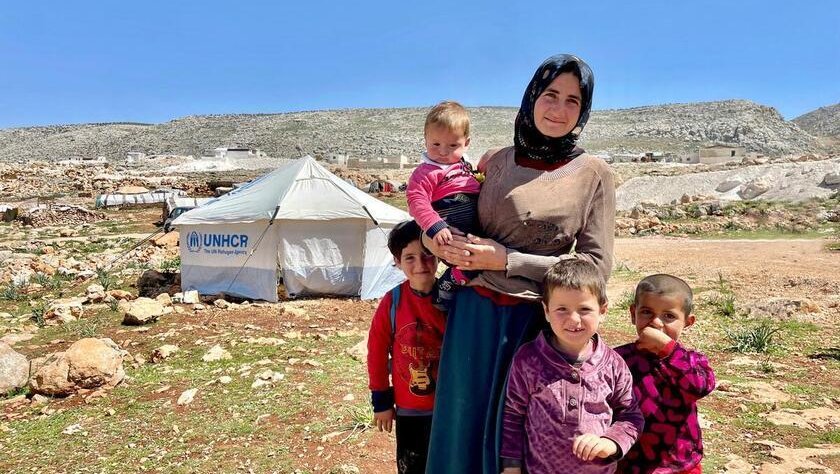
Reducing humanitarian need
Reducing humanitarian need is one of four key priorities in Ireland’s development policy. This requires close collaboration across the Department of Foreign Affairs and Trade and Government to ensure that our humanitarian response, development programme, climate action and peace building efforts address the root causes of increasing levels of need and build resilience for future shocks. This approach sits alongside Ireland’s efforts to provide immediate life-saving and emergency assistance in response to crises around the globe.
Ireland provides high quality humanitarian funding that is smart, fast and flexible. This supports our partners to respond rapidly, work where the needs are greatest, and provide the most appropriate type of assistance.
A significant portion of our humanitarian funding supports actions that anticipate shocks and stresses and respond before the onset of a large-scale humanitarian crisis. This approach is more effective, greater value for money, and most importantly, more humane. In addition, Ireland has led on supporting climate smart humanitarian response by ensuring that dedicated climate finance is allocated to our humanitarian partners to support adaptation in the most fragile contexts.
Ireland’s funding is informed by need and need alone. Ireland is recognised as a strong, principled donor, whose assistance is provided based on the humanitarian principles of independence, neutrality, impartiality and humanity. At least 90% of our country specific funding supports the most severe (level 4&5) humanitarian crises.
While Ireland supports large-scale crises such as Gaza and Ukraine, protracted and less visible crises such as Sudan, Democratic Republic of Congo, Myanmar and Afghanistan remain front and centre to our response. We have a strong focus on reaching those most in need, including women, girls and people living with disabilities and recognise that this requires a deliberate, system-wide approach.
Ireland recognises that there are no humanitarian solutions to humanitarian crises. Our approach in fragile contexts is one that acknowledges the multiple drivers and the need for a coherent response. Additionally, barriers to humanitarian access and violations of International Humanitarian Law (IHL) are becoming increasingly common and Ireland continues to steadfastly advocate for respect for IHL, protection of civilians and humanitarian aid workers, and accountability.
239 million
people around the world in need of humanitarian assistance
€330 million
In 2025, Irish Aid provided over €330 million in humanitarian funding to address unprecedented global crises
Despite humanitarian funding at an all-time high, the increasing number and duration of humanitarian crises means that the gap between humanitarian needs and available funding is widening. In 2025, Irish Aid provided over €330 million in humanitarian funding to address unprecedented global crises, focusing on conflict zones like Gaza, Sudan, and Ukraine, alongside climate-related disasters. Ireland has consistently been recognized for its "outsized role" in international aid, with a strong focus on underfunded and neglected emergencies.
Ireland’s approach to humanitarian assistance involves:
Reducing humanitarian need
Reducing humanitarian need is one of four priorities in Ireland’s international development policy, ‘A Better World’. It is an integral part of our foreign policy. It is also a clear expression of our values.
Reducing humanitarian need means recognising the urgency of providing life-saving humanitarian help. It also requires building the resilience of people most at risk. This is critical if we are to break the protracted nature of many crises and the need for repeated humanitarian interventions.
Humanitarian crises are increasing in number and duration. This is largely driven by conflict, climate change and economic shocks. The illegal war in Ukraine, conflict across the Middle East and Sudan, and a myriad of protracted and displacement crises globally, has stretched the humanitarian system to its limits. This has been compounded by a significant drop in resources across the development and humanitarian landscape which requires the system to be more effective than ever.
The Global Humanitarian Overview for 2026 identifies 239 million in need but with available resources, only 87 million are prioritised for life-saving support. It is critical that the root causes of need are addressed to prevent more people falling behind.
Humanitarian funding and leadership
Responding to ever increasing need, Ireland’s humanitarian funding has steadily increased. In 2025, Ireland provided over €330 million to support humanitarian crises across the globe. We are one of the top 20 humanitarian donors in the world.
Ireland is recognised as a strong and principled donor. Our assistance is based on the humanitarian principles of independence, neutrality, impartiality and humanity.
Our funding is directed towards the most severe humanitarian crises. We have a strong focus on forgotten and protracted crises that have fallen below the radar. Our funding targets those most in need, particularly women, girls and people living with disabilities.
Ireland’s funding is directed through a range of trusted partners – primarily the UN, the International Red Cross Movements (ICRC & IFRC) and NGOs. These partners have the experience and capacity to deliver assistance to the most vulnerable and hard to reach populations. Ireland is also channelling increasing levels of humanitarian funding to local and national humanitarian partners who are at the frontline of the response
As the humanitarian system undergoes significant reform, Ireland has stepped up to support actions related to the vision of the Emergency Relief Coordinator’s Humanitarian Reset, chairing the CERF Advisory Group and the Country Based Pooled Funds working group and engaging at the UN and EU level on the need for a coherent and coordinated global humanitarian aid architecture.
Ireland is committed to providing funding that is predictable, flexible and multi-year. Funding in this way has many advantages. It supports our partners to plan, programme and respond rapidly to urgent needs. It also facilitates longer-term programming that supports livelihoods and builds resilience. Critically, this type of funding builds a strong partnership with communities, local authorities and local NGOs.
Ireland provides dedicated funding to crisis specific appeals. In 2025, the top ten country recipients of Ireland’s humanitarian funding were:
Ukraine
Sudan
Syria
South Sudan
Somalia
The occupied Palestinian territory
Yemen
Ethiopia
Myanmar
Afghanistan
Anticipatory and climate smart humanitarian action
Ireland has increased support for ‘anticipatory action’ over recent years. A significant part of our funding supports early action that anticipates shocks and stresses before the onset of a large-scale humanitarian crisis. This approach is more effective, provides value for money, and most importantly, is more humane.
In addition, Ireland recognises that reducing humanitarian need and climate are increasingly interrelated. 80% of disasters are currently linked to climate change. We have increased the amount of climate finance that is channelled through the humanitarian unit to humanitarian partners like the OCHA CERF Climate Action Account, Start Ready and the International Federation of the Red Cross who are able to act quickly to support adaptation in the most fragile contexts.
Progressing the Sustainable Development Goals
The Sustainable Development Goals’ (SDGs) commitment to Leave No One behind means that the priority must always be to reach the most vulnerable people.
Progress towards reaching the SDGs is slowest in the most fragile contexts. In these settings, Ireland is committed to:
- supporting emergency cash and vouchers (SDG1)
- emergency food and nutrition (SDG2)
- emergency health services (contributing to SDG3)
- continuity of education (SDG4)
- health and water and sanitation services (SDG6)
Ireland’s humanitarian funding targets the specific needs and capacities of women and girls (SDG5). It is increasingly delivered in a way that is climate smart and climate proofed (SDG13).
Ireland’s development work, particularly on food systems, social protection, education and global health, also makes an important contribution to the SDGs in crisis settings.