


Durga Puja - An Indian festival with an Irish touch
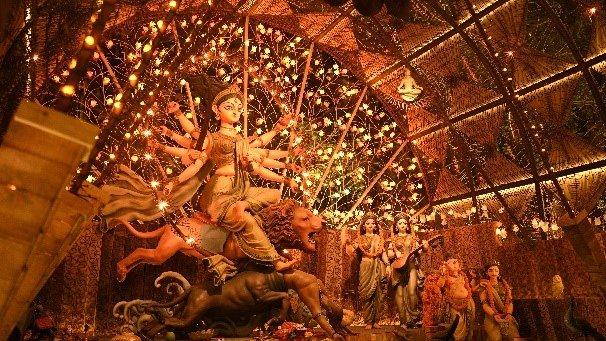
Durga Puja is the major annual festival in Kolkata and the state of West Bengal. It pays homage (puja) to the Hindu goddess Durga and celebrates her victory over the evil demon Mahishasura.
The festival unfolds over a ten-day period with the festivities take place during the last five days.
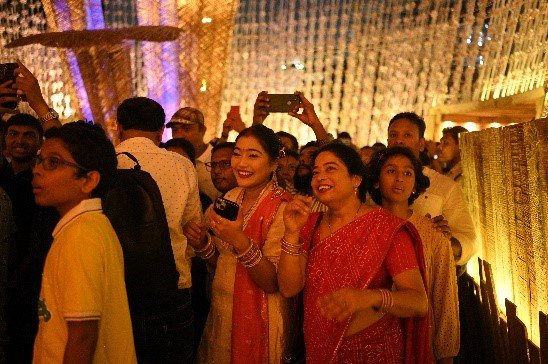
Not simply a religious event, Durga Puja is now proudly described as the world’s largest public art festival and attracts well over a million visitors each year.
Public art and pandals
Every year in West Bengal, community groups commission over 40,000 pandals [art installations featuring a clay idol of the goddess] with over 3,000 of these in Kolkata. These pandals vary in size from giant pavilion sized installations to small room-sized exhibitions.
The community groups, known as pandal committees, commission artists to design and build their community’s installation, using teams of artisans in the months leading up to the festival.
Each pandal has a theme, and is built using a mix of materials & techniques, often incorporating light and sound installations. They are often structures of enormous scale that allow hundreds of thousands of visitors to visit.
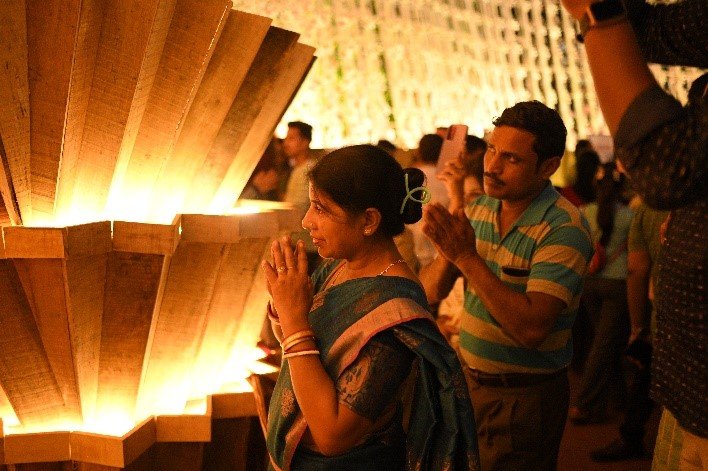
On the final day of the Durga Puja, all the idols of Durga are submerged in the Hooghly river and the pandal structure is dismantled.
Once confined to the Bengali community, the spectacle of Durga Puja is a major event in India and is now increasingly attracting global attention. The festival in Kolkata was inscribed on the UNESCO List of Intangible Cultural Heritage of Humanity in 2021.
Honouring Danu and Durga
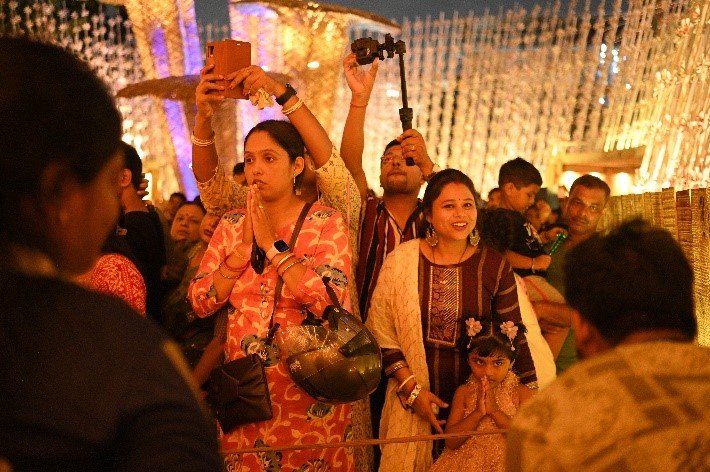
In 2024, Durga Puja took on an Irish dimension as Irish and Indian artists collaborated to create a pandal. Together, artists Lisa Sweeney, Richard Babington and Johnny O’Reilly from Irish spectacle company Macnas, and Sanjib Saha from Behala Nutan Dal, created an amazing work of art that honours both the Hindu goddess Durga and the Celtic goddess Danu.
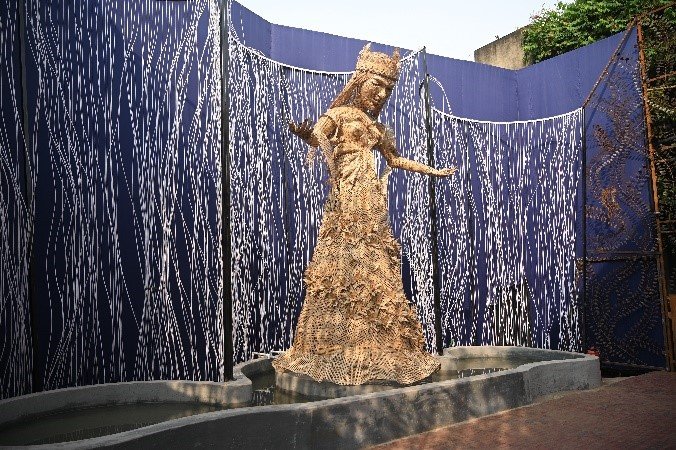
As part of this collaboration, Macnas contributed in two key ways: first, by designing a set piece that incorporates Irish cultural elements, and second, by working directly with Sanjib Saha, the lead artist, to integrate their designs with his, creating a seamless and cohesive installation.
The centerpiece of Macnas’ contribution was the representation of the Irish Goddess Danu, whose welcoming form allowed visitors to pass beneath her outstretched arms.
“This fusion of Irish and Indian creativity offers a visual spectacle that reflects the power of cross-cultural collaboration and celebrates the power of women and the feminine spirit.”
Danu’s design incorporates motifs from Ireland’s four major festivals—Samhain, Beltane, Imbolc, and Lughnasadh—along with a recurring flower theme, which aligned with the overall design of the Pandal.
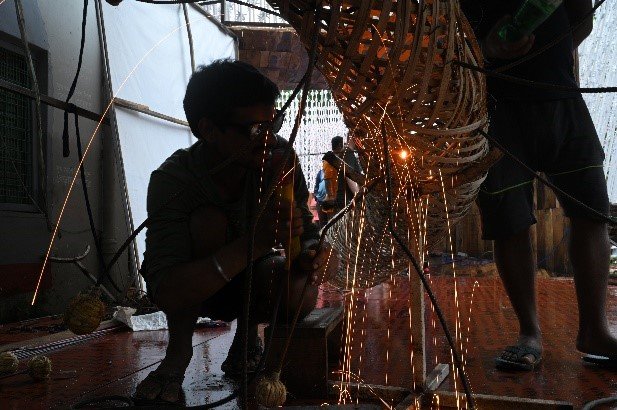
Artistic collaboration across borders
Initially conceived in a literal form, Danu’s figure evolved into a more conceptual representation as the collaboration progressed. Symbolising motherhood and warrior strength, Danu reflects qualities similar to those of the goddess Durga. The structure was crafted using traditional materials such as iron, wood, bamboo, and fabric, with the unique addition of a small pool of water at her base, which created a rippling light effect, highlighting her connection to rivers and the life-giving force of water.
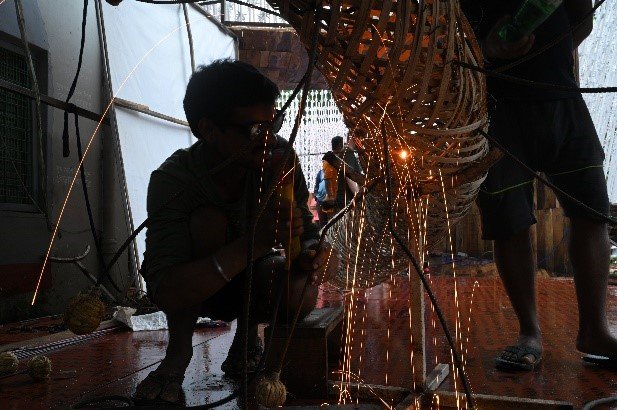
Lisa Sweeney says ‘’I made a traditional Irish cross, called Bridget’s cross, and it’s usually made from reeds from a field, but I made it with bamboo so it was very interesting to mix an Irish design with a traditional Indian material.’’
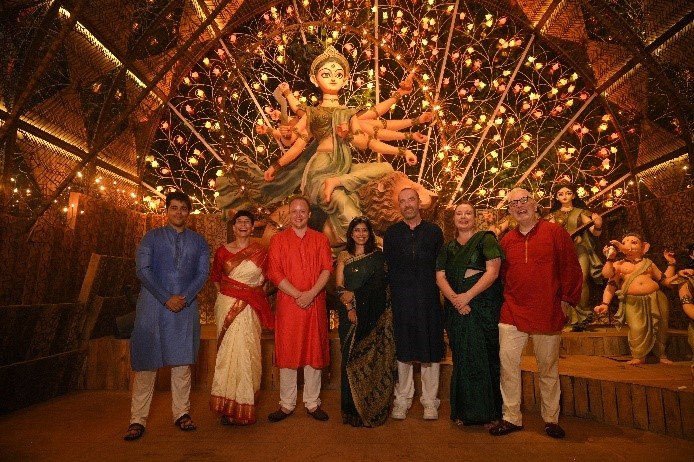
Sanjib Saha, the lead artist from India noted ‘’the best part of this give and take is that two artists are learning from each other despite being from different countries, of different nature and speaking different languages.’’
‘’We have a great understanding with each other despite our language differences. I do not speak fluent English and they do not speak fluent Bangla, yet we easily understand each other’s work and that is only possible through art. Art, in itself, is a language. ‘’