
The ‘perfumances’ of James Joyce’s Ulysses
James Joyce’s Ulysses is a novel famously rich in texture – linguistic, emotional, and sensory.
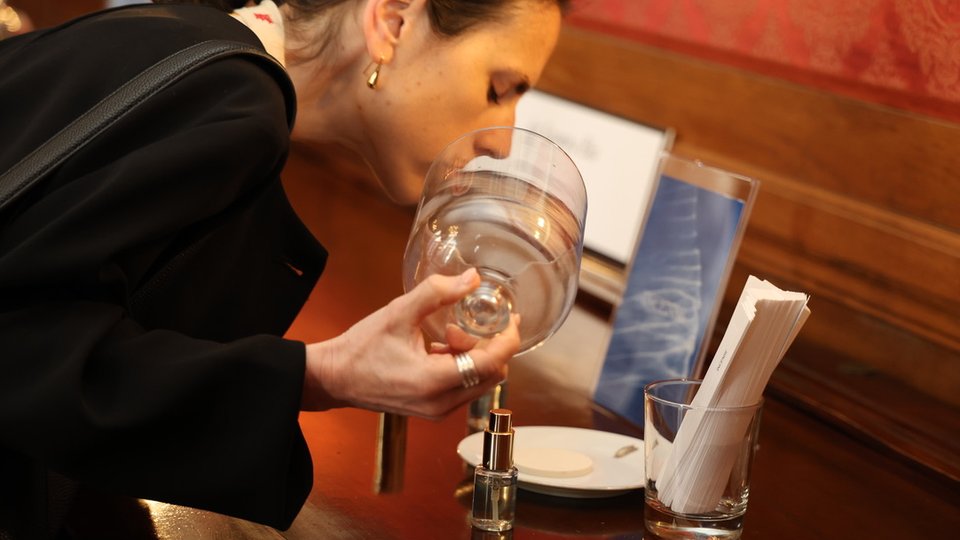
To celebrate Bloomsday, the Irish Embassy in Paris invited Irish perfumer Meabh McCurtin, who works for the renowned International Flavours and Fragrances in Paris, to create an interactive perfume experience exploring Ulysses through our sense of smell.
Working with Joycean scholar Christine O’Neill, Meabh created six original scentscapes or “perfumances” as Joyce might have called them, to interpret the themes of Ulysses, translating prose into perfume, to open a fresh sensory gateway into Joyce’s masterpiece.
From the narcotic hush of Lotus Eaters to the reverent swirls of church incense, these olfactory compositions summon the novel’s city - its streets, chemists, bedrooms and blooming gardens.
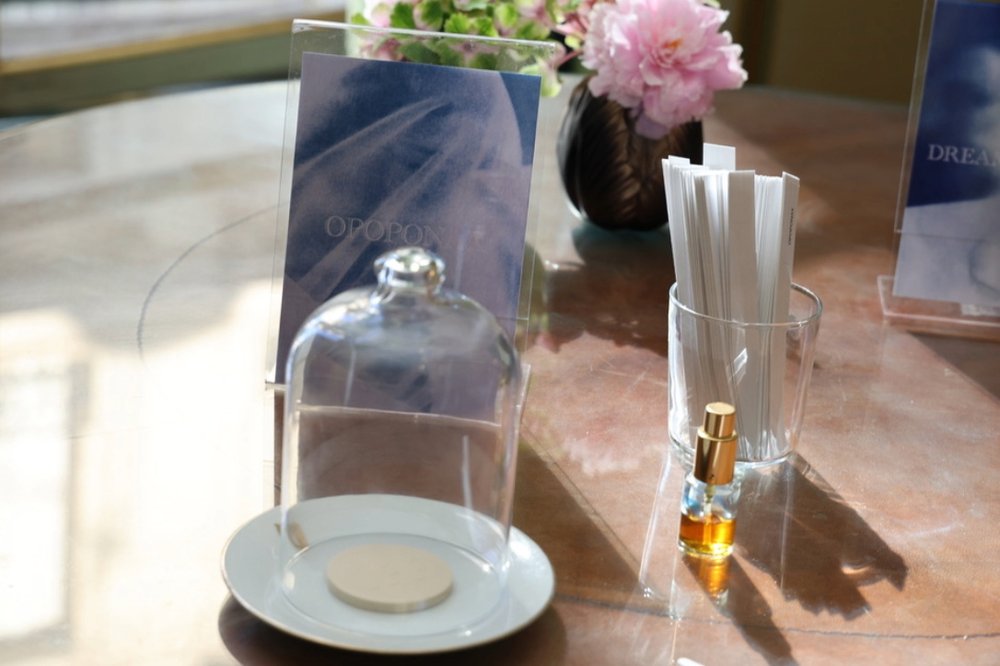
Each scentscape draws on Joyce’s own language and imagery, rendering the invisible currents of the book – its musks, its violets, its sulphurs – into something you can breathe and carry with you. What does a forgotten letter smell like? Or an afternoon at Sweny’s pharmacy? Or the ghost of a lover in the folds of old linen?
In Ulysses, smell is a trigger for memory, lust, grief, and sudden joy. These perfumes are not simply decorative. They are interpretive tools, offering a way to navigate the novel’s atmosphere and emotional depth. Ulysses is a book to be read with the whole body. An experience to be savoured. With this project, we invite you to linger and languish in it a little differently, to move between its rooms and pages and trace Dublin through the traces it leaves behind.
Read Christine O'Neill's introduction to the project below
These two sentences in the Lestrygonians episode of Ulysses deserve our special attention. Joyce told his friend Frank Budgen in Zurich that it had taken him all day to write them. When Budgen wondered whether he had been seeking the mot juste, Joyce said, ‘No … I have the words already. What I am seeking is the perfect order of words in the sentence. There is an order in every way appropriate. I think I have it.’ (Budgen, James Joyce and the Making of Ulysses, Oxford University Press: 1989: 20).
The two perfectly-arranged sentences are about Bloom, who is looking at the shop windows of Brown Thomas. He is seduced by the ‘[g]leaming silks, petticoats on slim brass rails, rays of flat silk stockings’ (8.631/2). Haunted by the idea that his wife Molly may betray him this very afternoon, he decides that it was ‘[u]seless to go back. Had to be.’ (8.633)
I think that Bloom’s pain, the psychological strain he is under as well as his aroused senses are perfectly caught in Joyce’s sentences. More generally, it is true to say that Ulysses often combines references to smell, whether pleasant or unpleasant, with allusions to other senses.
These suggest that a character is in a heightened state of sensory perception, which may even be reflected in the syntax itself.
Perfume of embraces all him assailed. With hungered flesh obscurely, he mutely craved to adore.
Odours affect us on a physical, psychological and social level, yet smell is probably the most undervalued sense in the modern Western world. Moreover, smell is notoriously difficult to capture in words – it is highly elusive and has rightly been called inarticulate. The relevant vocabulary is amazingly limited, and if a reader is unfamiliar with a particular smell, no amount of description will be able to evoke it.
Yet olfactory sensation is heavily loaded with affective tone and is hence often used as a means of characterisation. Bound up with memories, it is highly subjective and hence intimate and emotional. It is the sense that pre-eminently mingles outer and inner as smells surround and penetrate us even more ineluctably than sounds. You can shut your eyes or stop your ears, but you cannot hold your breath for long.
In Joyce’s works, we encounter both astonishing scentsibilities and intriguing scentscapes – or ‘perfumances’, a word Meabh has borrowed for this project from Finnegans Wake (219.5). Already A Portrait of the Artist as a Young Man is pervaded by smells, perfumes, odours, and stinks – an unusual trait, as some early reviewers pointed out, e.g. H.G. Wells, who diagnosed a ‘cloacal obsession’. Obviously, Joyce was not writing traditional fiction.
Indeed, Joyce’s main protagonists are shown to be in tune with their bodies, listening to and interpreting its signs. The mature and sensual Bloom is sensible to odours and perfumes all day long, from being ‘seated calm above his own rising smell’ in the outhouse after breakfast (4.512/3); to remembering Boylan having had ‘a good rich smell off his breath dancing’ (4.529/30); to sniffing the odour of his lacerated toenail before going to bed.
While such potentially offensive smells in texts may make readers smile, they are likely to do so only because their malodorous appeal remains innocuously conceptual. There is a remarkable distance, and difference, between imaginative evocation and actual sensory experience.
And this is where Meabh McCurtin’s scentscapes make such a delightful difference. While basing all her creations for this Bloomsday on the text of Ulysses, she has brought her professional knowledge as a perfumer as well as her remarkable creativity to her chosen ‘perfumances’. For all Joyce’s artistry, his medium was words, and no words can convey olfactory notes.

Perfumer
Meabh McCurtin
Meabh Mc Curtin is an Irish fine fragrance perfumer, working for International Flavors & Fragrances in Paris.
She grew up in Co Clare on the west coast of Ireland and studied biochemistry at the National University of Ireland, Galway. Meabh holds a master’s degree in molecular biology from the Ecole Normale Superieure, Lyon.
She was trained as a perfumer by IFF’s master perfumer Dominique Ropion and has worked internationally in New York, Dubai and now based in Paris. Her latest creations include Maison Margiela Under the Stars and Burberry Golden Haze.

Scholar
Christine O'Neill
Christine O’Neill studied at Trinity College Dublin and the University of Zurich.
Her Ph.D. thesis was a stylistic study of the Eumaeus episode in Ulysses, and since then she has published on various aspects of Joyce’s works.

Actor
Clara Simpson
Clara Simpson is an Irish actor living and working between France and Ireland.
She studied at Cours Florent, Paris and was an associate artist of the Theatre National Poplulaire.