


A house of memory
Literary links between Ireland and France 1922 to 2026
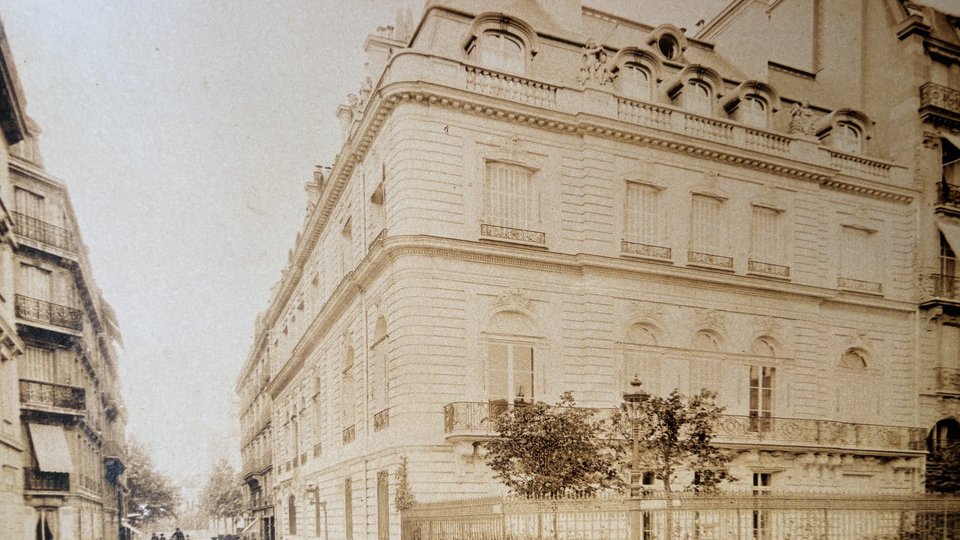
At 12 Avenue Foch in Paris stands a townhouse built in the late nineteenth century, today home to the Embassy of Ireland.
Behind its doors lies a story far larger than that of a diplomatic address: a story of family, literature, and a bond between two countries that has lasted well over a century.
A house of memory
"I think this building is a wonderful metaphor for the relationship between Ireland and France," says former Ambassador of Ireland Niall Burgess. The history of the hôtel particulier is told from the inside by the Comte de Breteuil, whose great grandfather oversaw the construction in 1892. Henri de Breteuil was, at the time, a prominent figure in Parisian society," a friend of Edward VII, King of England, of the Queen of Portugal, and of Marcel Proust”. To entertain the high society in which he moved, he commissioned the architect Sanson and chose the most prestigious part of Paris, what was then the Avenue du Bois de Boulogne.
The connection to Proust runs deeper than social friendship. "My great-grandfather was one of the prominent figures of the Parisian aristocracy, and Proust drew inspiration from him," the Comte de Breteuil recounts. Henri de Breteuil became the model for the character of Hannibal de Bréauté in À la recherche du temps perdu, the shared initials a nod by Proust to his friend.
As former Ambassador Niall Burgess notes "The connection between Irish writers and France is absolutely remarkable. Oscar Wilde, for example, grew up speaking French and wrote in French. James Joyce published one masterpiece in Paris and wrote another." He recalls the famous, almost absurd story of the only meeting between Joyce and Proust, in a Paris hotel in 1922, and adds that both writers were trying to achieve the same goal. Joyce once said Ulysses could be used to completely reconstruct the city of Dublin in 1904, "and in a sense, Proust did exactly the same thing. He recreated, out of memory, an entire world."
That literary dialogue between France and Ireland is still very much alive at the Embassy today. Every year, more than 6,000 visitors pass through its doors, many during the Journées du Patrimoine (European Heritage Days). As former Ambassador Niall Burgess puts it: "The Embassy [in Paris] is not just telling a story about architecture, or interior decoration. It tells a story about a connection that is old but is vibrant today, and important for the future."