


Africa Ireland Trade Horizons Conference, 2025
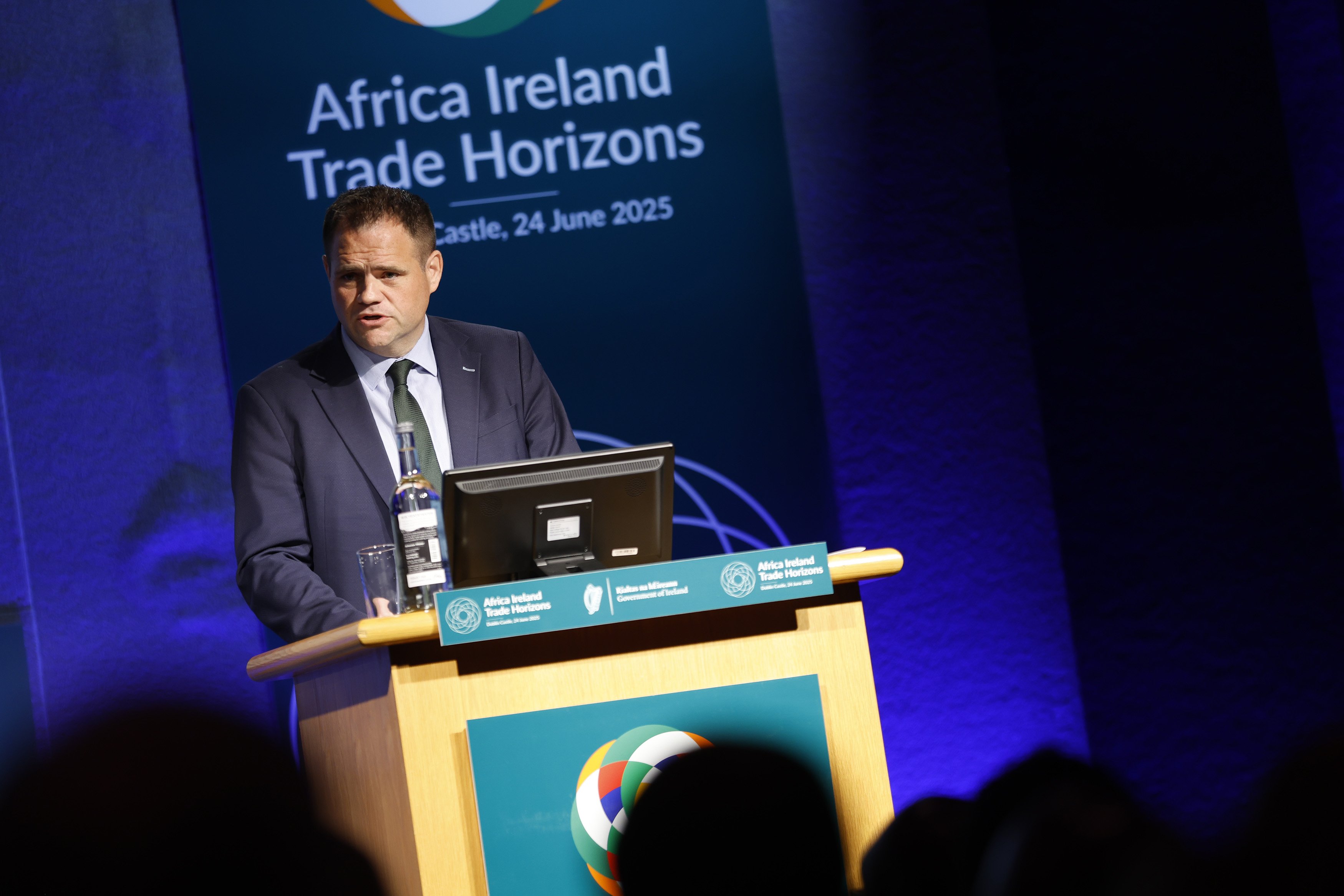
By Neale Richmond, Minister for International Development and Diaspora.
What if I told you there is a region of the world where trade with Ireland is growing at 8% annually and now represents an equivalent export market to Australia, New Zealand and South America combined?
You probably wouldn’t think I was talking about Africa, but I am.
Ireland’s relationship with Africa is often viewed solely in terms of aid. Whether through Ireland’s incredible NGOs, our historic missionary network or through Irish Aid, the Government’s development assistance programme, Ireland plays an enormously positive role in the lives of millions of people across Africa, particularly women and girls.
Fastest growing economy
But Africa’s story cannot be categorised solely in terms of poverty, hunger and conflict. Africa is home to the world’s youngest population and 11 of the 20 fastest growing economies on the planet.
The economic potential of Africa is enormous. We cannot underestimate the challenges it faces, but demographics alone will power Africa’s economy over the coming years. Around 60% of Africa’s population is under the age of 35. It is a continent facing into an innovation boom. By 2035, there will be more young Africans entering the workforce each year than in the rest of the world combined.
Record levels of trade
Trade between Ireland and countries across Africa is at record levels and has the potential to grow significantly in the years ahead. Total trade in goods between Ireland and Africa grew to €2.6 billion in 2024. Trade in services accounts for in excess of a further €6 billion.
Agri-food exports are a key element of Ireland’s exports to Africa, valued at €914 million in 2024, up 7% on 2023 levels. Trade in dairy, seafood and beverages are all growing strongly.
Ireland now exports over 6,000 tonnes of cheese to Egypt annually. Over 3,000 tonnes of Irish butter ends up on supermarket shelves in Morocco. Agri-food trade works both ways: we import €26 million worth of tea from Kenya each year.
Economic potential
As a small, open economy Ireland is always looking to build new markets. With a population of approximately 1.5 billion, two-thirds of whom are under the age of 35, the economic potential of Africa as an export market for Irish businesses is huge.
In an unstable global economic environment, where new markets are constantly being sought, looking south to Africa – with its youth bulge and growing middle class – is something Irish business needs to be looking at.
That is the central theme of the Africa Ireland Trade Horizons Conference which will take place in Dublin Castle on Tuesday, 24 June. Business leaders from across Africa and Ireland will gather to analyse the opportunities that exist and seek to build trade further in the years ahead. Over 500 delegates from a variety of industries will attend.
Vital sectors
I believe this conference is an important step in reframing Ireland’s relationship with Africa. When I meet African governments, they are deeply thankful for the assistance Ireland continues to give across vital sectors such as education and healthcare, but what they press me on is how can we build our trading links? How can private sector investment from Ireland generate the good, well paid jobs their young populations are crying out for?
Countries across Africa study Ireland’s economic transformation as a model. They take inspiration from a country that has moved from having high levels of poverty and emigration to a country that is, for all its imperfections, one of the most successful trading countries in the world.
Progress and resilience
That is the future they want for themselves. Despite the many challenges that still exist, progress is being made. Economic growth in Sub-Saharan Africa is showing some resilience despite uncertainty in the global economy. Regional growth is expected to reach 3.5% in 2025 and accelerate to 4.3% in 2026-2027.
None of this can hide from the huge challenges that remain across the continent. Poverty and conflict continue to scar the lives of too many people. Poor infrastructure, trade barriers and corruption hinder the willingness of private sector companies to look to Africa as a prospective market.
Clearly there is much to do to enhance Africa’s reputation – both perceived and real – as a place to do businesses. Much of sub-Saharan Africa needs improved public services, stronger governance and regulation that strengthens not inhibits business.
This is where the development assistance for which Ireland is known across Africa plays a key role. In many cases aid is fundamentally about saving lives, but development cooperation is also about raising systems, structures and living standards to a point where people no longer need it.
Development cooperation
Ireland invests in development cooperation primarily because it is the right thing to do, but there is a clear overlap between our values and our interests. As we invest in Africa’s development, we will reap the rewards in terms of creating new markets to help power Ireland’s economy in the decades ahead.
Conflict and poverty are tragedies on a human level. They also restrict a country’s ability to develop economically. That, in turn, is a negative for countries such as Ireland who are actively looking for new markets to trade with.
The moral argument for investing in Africa has always been clear. The business case for doing it has never been stronger.
Neale Richmond is the Minister for International Development and Diaspora.