


Drug control and penal policy
The United Nations Office of Drugs and Crime is the primary global forum for drug control and penal policy.
The organisation acts as a normative leader, promoter of research and source of technical assistance for the member-states of the United Nations, in a field of responsibility divided into five thematic areas:
- Crime prevention and criminal justice
- Terrorism
- Drugs
- Transnational and organised crime
- Corruption
Joint governance
UNODC is governed jointly by two Commissions: the Commission on Narcotic Drugs and the Commission on Crime Prevention and Criminal Justice.
The organisation convenes both commissions on an annual basis, as well as conferences for the state parties to UN conventions such as the Convention on Trans-national and Organised Crime (UNTOC) and the Convention Against Corruption (UNCAC).
Soon, the first conference will be convened for parties to the Convention on Cybercrime, following the Convention’s adoption in 2024.
World Crime Congress
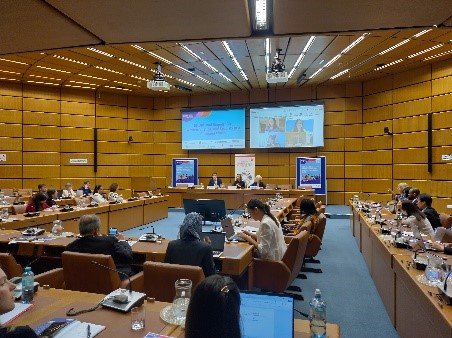
Once every five years, the UNODC organises the World Crime Congress, which is an advisory body composed of practitioners, researchers and national authorities in the field of crime prevention. In between these larger events, the UNODC facilitates thematic gatherings of international experts, who share research and best practice on drug control and penal policy.
UN Drug Control Conventions
Ireland has ratified all three UN Drug Control conventions (1961, 1971 and 1988). From January to June 2025, Ireland served as chair of the Western Europe and Others regional group, allowing it to take an enhanced role in the work of the UNODC’s various bodies.
During this period, Ireland hosted a side-event at the 68th session of the Commission on Narcotic Drugs, focusing on the country’s experience with citizens’ assemblies as a model for community-led drug policy development.
Ireland’s assumption of the Presidency of the Council of the European Union in the second half of 2026 will provide us with an opportunity to play an increasingly prominent role in coordinating EU partners’ engagement with the UNODC.